In November 2025, I presented a workshop on ‘Literacy and AI’ at the NSW English Teacher’s Association Conference. Like most teachers, I had been grappling with the issue of AI in the classroom- What was its place? Will AI use harm or benefit our students?
Ancient Greek mythology gives us the lessons from the opening of Pandora’s Box, and I personally feel that teachers need to accept that AI is here, our students are using it, and we need to find ways to make it benefit learning outcomes. Hence. .. the idea for my workshop “Literacy + AI” working collaboratively to improve student vocabulary and reading skills.
One simple strategy to add to your teaching repertoire is to take the often used “Think…Pair…Share…” strategy and add the extra component of asking AI for input.
At the workshop, I asked teachers to individually think of words to describe two characters they had just read about in a passage from “To Kill a Mocking Bird” by Harper Lee. In order to provide scaffolding (similar to what I would offer in the classroom) I gave the participants a table and provided a few examples of describing words for Scout and Miss Caroline. After thinking individually, I asked participants to pair up and share the words they had brainstormed, encouraging them to use suitable words from each other’s lists.
I then provided a powerpoint slide with a list of descriptive words that Chat GPT had provided when asked to describe the characters in the passage. I then encouraged the participants to read through the AI generated word bank, choosing suitable words
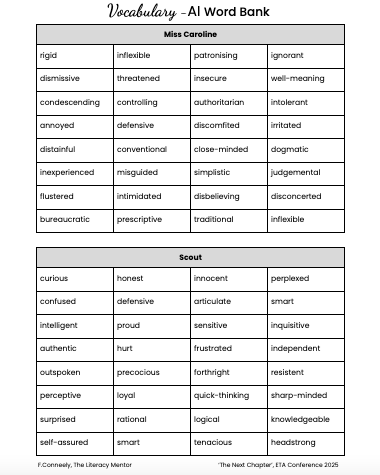
.By adding the AI input, I was able to extend the student’s vocabulary by including words such as dismissive, condescending, bureaucratic for Miss Caroline and authentic, sharp-minded, forthright, tenacious for Scout. The AI input acted as a more sophisticated model for vocabulary, effectively moving the students from more simplistic language to more sophisticated choices. This strategy effectively utilised the Vgotsky’s Zone of Proximal Development by providing scaffolding between what the students are able to do on their own and what they can achieve with guidance.
Another useful suggestion for teachers to implement this strategy is to pre-locate the AI input and give it to students. By adding this step, teachers can prevent students from going off on tangents on their computers and can allow access to AI input if there are firewalls in place at their school.
My personal reason for providing the input was that I deliberately wanted more sophisticated language choices, so finding the words myself allowed for this screening process to happen. Improving vocabulary is essential for improving reading and writing outcomes in the classroom. As teachers it is important to realise that “all students can benefit from high-quality vocabulary instruction. Even students who have a large vocabulary repertoire can enrich their knowledge in ways that make it more accessible and productive” McKeown (2019)
Resources:
-
Beck, Isabel L., McKeown, Margaret G., and Kucan, Linda. (2002). Bringing words to life. The Guilford Press
-
Beck, I. L., McKeown, M. G., & Kucan, L. (2008). Creating robust vocabulary: Frequently asked questions and extended examples.The Guilford Press
-
McKeown, M.G, (2019) Effective Vocabulary Instruction Fosters Knowing Words, Using Words, and Understanding How Words Work Language, Speech, and Hearing Services in Schools, Vol. 50 , 466–476, Accessed from https://files.eric.ed.gov/fulltext/EJ1234125.pdf, October 2025